Backlinks remain one of the strongest signals for search engine rankings, directly influencing a site’s authority, visibility, and organic traffic. Yet building high-quality links manually is time-consuming, complex, and often inefficient without the right systems in place. That’s where specialized SEO link building tools enter the equation—helping teams identify opportunities, analyze competitors, automate outreach, and monitor progress with precision.
This guide breaks down the most effective SEO link building tools available today, grouped by their core functions: backlink analysis, outreach and relationship management, prospecting, and campaign tracking. Whether you’re managing a solo campaign or scaling link acquisition for an agency, you’ll walk away with a tailored toolkit to improve your approach and get results faster.

Stronger SEO Begins with Smarter Backlink Analysis Tools
Backlinks serve as ranking signals and trust indicators, which makes understanding their structure and quality a fundamental component of any SEO campaign. Poor backlink quality doesn’t just dilute authority—it introduces risk. That’s why thorough backlink analysis isn’t optional. It’s non-negotiable.
Why Analyzing Your Backlink Profile Directly Impacts Rankings
Every site accumulates backlinks over time—some natural, some nurtured, and unfortunately, some toxic. Without periodic audits, what started as a healthy link profile could transform into a liability. Unnatural spikes in link acquisition, irrelevant anchor texts, or over-reliance on low-quality domains all degrade a site’s authority. Google’s algorithm detects these patterns, and penalties follow.
By using advanced backlink analysis tools, SEO professionals monitor trends, identify problematic domains, and track the fruits of their link-building efforts with precision. The result: optimized link equity and minimized risk.
Tools That Redefine Backlink Discovery and Insights
-
Ahrefs — With one of the largest third-party backlink databases, Ahrefs provides extensive link intelligence and historical data. Users can analyze Domain Rating (DR), referring domains, and link acquisition or loss over time. The Link Intersect feature identifies domains linking to competitors but not to your site, revealing missed opportunities.
-
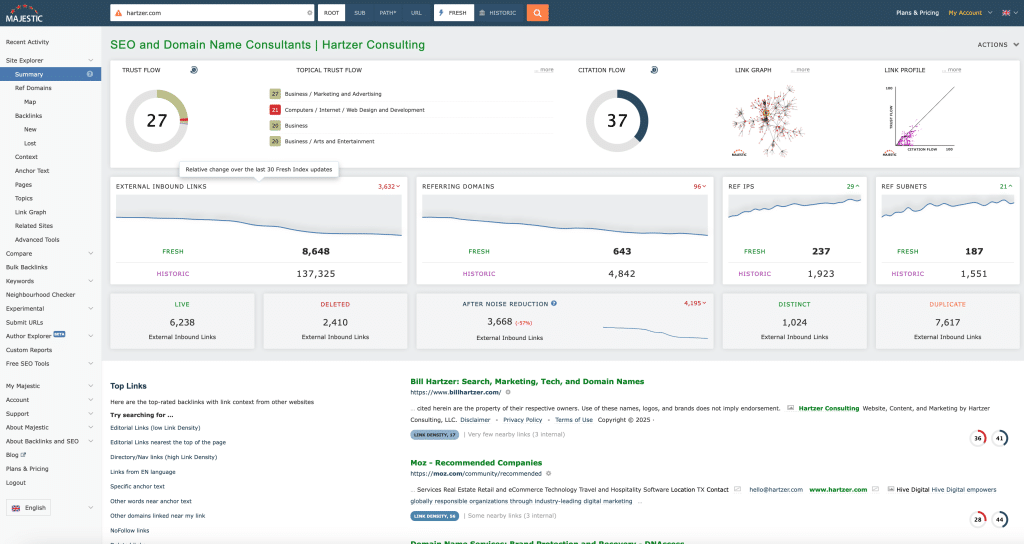
Majestic — A long-established authority in backlink analytics, Majestic is known for its Trust Flow and Citation Flow metrics, which quantify both link quality and influence. Its Site Explorer tool visualizes link profiles, anchor text distributions, and topical categories, making it invaluable for understanding a domain’s true authority and link neighborhood. Majestic’s massive, continuously updated index makes it a staple for forensic backlink research and competitive SEO audits.
-
SEMrush — SEMrush blends backlink tracking with anchor text and toxic link analysis. Its backlink audit tool flags potentially harmful links and connects directly to Google’s Disavow Tool. Detailed growth charts and trend reports enable users to track link velocity, monitor competitors, and measure progress across specific timeframes.
-
Moz Link Explorer — Moz emphasizes Domain Authority (DA) and Page Authority (PA) as key indicators of link strength. Its explorer highlights new, lost, and top backlinks by URL, with flexible filtering for spam score, link type, and domain category. Moz’s clean interface and export options make it ideal for quick link profile snapshots or client reporting.
Key Metrics and Features That Drive Insight
Not all backlink analysis tools offer equal depth. The following features drastically improve SEO visibility and decision-making speed:
- Website-Level Backlink Overviews – Visual snapshots of linking domains, total links, and linking IP diversity establish a baseline for link profile health.
- Historical Data Visualization – Being able to compare link figures across months or years reveals the impact of ongoing campaigns or algorithm updates.
- Anchor Text Distribution – Tools that break down the frequency and relevancy of anchor texts used across backlinks make it easier to prevent over-optimization or detect unnatural link-building strategies.
Uncover Competitor Strategies with These Link Research Tools
Peering into the backlink profiles of competitors reveals more than just where they’re earning links—it clarifies their strategies, highlights opportunities you’ve missed, and identifies patterns that influence rankings in your niche. With the right tools, dissecting their link ecosystems becomes a structured, data-driven process.
Identify Link Sources Competitors Depend On
Every backlink leaves a trail. When you follow that trail across top-ranking pages in your industry, you’ll surface domains repeatedly linking to multiple competitors. These high-frequency domains usually signal relevance, authority, or both. Filtering backlink reports to detect these intersections can pinpoint your next outreach targets.
Tools Offering Deep Competitive Intelligence
-
SpyFu — Originally built for PPC and organic keyword tracking, SpyFu now delivers backlink intelligence that reveals which domains link to your competitors, how frequently, and to which specific pages. Its Backlink Kombat feature uncovers valuable linking opportunities your site has yet to earn but competitors already have.
-
SEMrush — Beyond keyword and traffic analytics, SEMrush provides powerful backlink comparison tools for competitive research. Users can benchmark their link profiles against rivals, identify shared and unique referring domains, and analyze anchor text distributions. The platform’s historical data visualizes backlink growth trends, helping pinpoint when and why competitors gained momentum—whether through content launches or outreach campaigns.
Together, these tools offer actionable insights into link-building strategies, allowing SEO professionals to spot patterns, gaps, and potential partnerships that can strengthen their competitive edge.
Find High-Authority, Low-Competition Opportunities
After pulling competitor backlink data, apply custom filters to sort by domain authority, dofollow status, referring domains, and traffic estimates. This process strips away noise and leaves only high-value targets for acquisition. Majestic.com enhances this step significantly by visualizing your top competitors’ link networks through Link Graph, enabling pattern analysis across link clusters rather than isolated pages.
Curious whether multiple competitors get linked from the same editorial blogs or curated lists? The Link Graph highlights these common backlink sources instantly.
Outreach Automation Tools That Simplify Your Link Building Workflow
Coordinating a successful outreach campaign for link building demands more than just a polished email and a list of prospects. Automating repetitive tasks—without losing the personal touch—significantly increases efficiency and improves response rates. This is where outreach automation tools come in. These platforms allow SEO professionals to scale their link acquisition efforts while maintaining consistency and precision.
Top Platforms for Outreach Campaign Management
- Mailshake – Designed specifically for sales and marketing teams, Mailshake makes outreach easy through automated email sequences, built-in A/B testing, and native CRM integrations. It supports Gmail and Outlook, allows for CSV prospect imports, and supplies real-time analytics for open, reply, and conversion tracking.
- Pitchbox – Known for its seamless workflow, Pitchbox combines prospecting, email outreach, and relationship management within a single interface. Used widely in link building campaigns, it features advanced filtering, customizable outreach pipelines, and personalized automation. Integration with tools like Moz, SEMrush, and Majestic.com lets users evaluate metrics directly within campaigns.
- BuzzStream – This platform functions both as a robust outreach solution and a CRM designed for managing relationships with webmasters. BuzzStream lets users discover contact information, schedule personalized email sequences, and maintain contact history. It tracks opens, clicks, and responses, giving full visibility into campaign performance.
Core Features That Drive Effective Outreach
- Custom Email Templates – All three platforms allow the use of personalized email templates, with dynamic fields that pull in prospect data such as names, websites, or niche relevance. This saves time while retaining a tailored tone.
- Integrated Website CRM – BuzzStream and Pitchbox provide embedded CRMs focused on managing domain-level relationships, not just individual contacts. This supports long-term relationship building that can bring recurring backlink opportunities.
- Email Follow-Up Sequences – Each tool supports automated follow-up systems. Users can schedule specific intervals, conditions (e.g., if no reply), and message variants for follow-ups, increasing response and conversion rates without manual monitoring.
Whether running a lean outreach operation or managing dozens of campaigns per month, automating your email sequences and follow-ups will accelerate link-building results. For large-scale campaigns, Pitchbox.com provides enterprise-grade capabilities while keeping user control over personalization and relationship tracking.
Unlocking SEO Opportunities with Broken Link Building Tools
Every broken link on the web opens a door for someone else. Spotting these gaps and offering relevant replacements gives you a direct route to high-quality backlinks. This tactic scales effectively and often produces results faster than traditional outreach, especially when paired with the right tools for discovery and replacement.
Broken Link Discovery Tools
Scanning the web manually for broken links is inefficient and unsustainable. That’s where these dedicated tools come in:
- Check My Links (Chrome Extension): This extension quickly scrapes through any web page and highlights all valid and broken hyperlinks. Green means working; red marks the broken ones. Ideal for fast audits during content review or while browsing a potential link partner’s blog.
- Screaming Frog SEO Spider: This desktop software crawls websites at scale. In moments, it pulls out 404 errors across an entire domain. Filter by response code, extract broken outbound links, and export them for outreach—Screaming Frog handles both surface-level scans and deep technical audits.
Refined Outreach That Converts
After finding broken links, the next step is outreach—handled poorly, even the most relevant replacement will be ignored. Structure outreach emails to provide value from the outset. Mention the exact broken link. Explain why your suggested content fits. Keep it concise, respectful, and actionable.
Use Pitchbox.com to scale this process. It automates contact discovery, manages personalized outreach sequences, and tracks response rates. With campaign insights and automatic follow-ups, Pitchbox improves the odds of securing a replacement link without micromanaging every lead.
Make every dead link on the web a living opportunity. Combine real-time discovery with strategic outreach, and broken link building becomes more than a tactic—it becomes a predictable, repeatable process.
Precision in Anchor Text: Tools and Tactics for Smarter Optimization
Why Anchor Text Optimization Influences SEO Outcomes
Anchor text isn’t just clickable text—it’s a contextual signal for search engines. Overuse of keyword-rich anchors leads to penalties, while underuse weakens SEO impact. Search algorithms like Google’s Penguin prioritize relevance, diversity, and natural language. Getting the balance right boosts topical authority and link profile integrity.
Tools Tailored to Track and Optimize Anchor Text
- Linkio: This platform reverse-engineers anchor text strategies based on target keywords and existing backlink profiles. It generates ratio recommendations—like branded, generic, exact match, partial match—so SEO teams avoid unnatural link signals. Linkio also provides automated tracking against a campaign’s goals, reducing manual audits.
- Ahrefs: Known for its comprehensive backlink database, Ahrefs offers detailed anchor text breakdowns. Users can filter anchors by referring domain type, link type (dofollow vs. nofollow), and link placement. Its historical comparison feature supports ongoing anchor text refinement across time.
Distribution Guidelines for a Natural Link Profile
Industry studies and SEO case data indicate that successful websites maintain anchor text distributions like the following:
- Branded Anchors: 40–60% — includes company names and domain references.
- Generic Anchors: 10–20% — such as “click here” or “this site.”
- Exact Match: under 10% — targets precise keywords; overuse can trigger filters.
- Partial Match: 10–20% — blends brand, URL, or context with keywords.
- Naked URLs: 5–15% — raw website addresses without anchor words.
Smart anchor text optimization mirrors natural human linking patterns. Search engines respond more favorably to varied context than to tactical rigidity. Using Linkio to plan your distribution and Ahrefs to monitor shifts ensures constant alignment with algorithmic expectations.
Link Prospecting Solutions That Deliver Real Opportunities
Finding Relevant Websites with Precision
Effective link building begins with identifying high-quality, niche-relevant websites that align with your content and audience. Precision in prospecting filters out unrelated domains and amplifies potential for successful outreach. Using advanced parameters such as topic relevance, domain authority, traffic levels, and backlink profiles refines this process further.
Layered search strategies, powered by a combination of automation, manual refinement, and intelligent filtering, will consistently uncover stronger backlink prospects faster than general browsing or keyword searching alone.
Automated Discovery Tools That Accelerate Prospecting
- Respona: Designed with link building campaigns in mind, Respona combines AI-driven prospecting with content matching. It identifies potential linking websites based on topical relevance and outreach fit, while also handling bulk personalization of outreach emails and follow-ups.
- Hunter.io: Hunter makes connecting with your targets seamless by automating email address discovery. After identifying potential sites, use Hunter to locate verified contact emails for editors, marketers, or contributors—cutting manual effort to a fraction.
Want to expand into new link verticals or topics? Feed Respona a competitor’s URL or keyword; watch it deliver a curated list of possible linking sites already engaging in similar content narratives.
Custom Search Queries & Targeted Filtering
Advanced Google search operators offer unmatched granularity when used effectively. Combine inurl:, intitle:, “write for us”, or “become a contributor” phrases with your target keywords to surface lesser-known opportunity pages that algorithmic tools often miss.
Here’s where strategic layering shows its value: export link prospects from search results, analyze their historical backlinks using Majestic.com, and map their connection graph in Link Graph. This reveals mutual connections, link neighborhoods, and potential outreach angles already trusted within your niche.
Want to go deeper? Reverse-engineer successful outreach campaigns of your competitors using tools like Majestic.com. Their comprehensive backlink database and flow metrics will uncover affinity patterns among referring domains—signaling where your pitch will resonate most.
Bring It All Together with Workflow Integration
Once the prospect list is ready, streamline outreach operations using Pitchbox.com. It lets you import domains, segment campaigns, auto-personalize emails, track replies, and schedule follow-ups—creating a structured, repeatable prospecting system from discovery to delivery.
Combining link prospecting tools with analytical and outreach platforms creates a complete ecosystem: find relevant targets, validate their authority, build contact databases, and launch outreach—all from a unified process. Scale intelligently without sacrificing personalization.
Find Guest Posting Opportunities with Specialized Databases
Systematic guest posting demands more than a random Google search. To scale efficiently, link builders rely on curated databases that aggregate blogs and websites actively accepting guest contributions. These platforms eliminate hours of manual research by providing essential filtering options—such as domain authority, niche relevance, and editorial guidelines—right at your fingertips.
Databases That Streamline Guest Post Discovery
- MyBlogGuest One of the original communities devoted to guest blogging, MyBlogGuest connects publishers seeking high-quality content with marketers and writers offering articles. It enables two-way communication between content creators and site owners looking to populate their blogs with fresh, relevant perspectives. Although the platform has evolved and implementations vary, the legacy database still proves useful for certain verticals.
- OutreachMama OutreachMama offers both done-for-you services and access to a vetted inventory of guest posting opportunities across a wide spectrum of niches. Their database includes detailed site metrics—including traffic estimates and domain ratings—and facilitates filtered searches based on niche, country, or keyword. The integration with popular SEO tools enhances targeting precision.
Tactics to Personalize Your Guest Post Pitch
Most inboxes flooded with templated outreach emails go ignored. Precision and relevance change that. Start by referencing a recent post or social media update from the prospective blog. This demonstrates genuine engagement with their content. Mention how your proposed article adds something new—not just more of the same. If you’ve written similar content before, link to it to build trust.
Also, highlight shared connections or mutual topics of interest. Use first names when known. Avoid sending emails with generic subject lines like “Guest Post Inquiry”—instead, propose a title that connects with their content vertical. A tailored pitch with a unique article idea creates context quickly and increases your chances of getting a positive response.
Tracking Domain Authority, Trust Flow and Comparable Metrics for Strategic Link Building
Key Metrics That Determine Website and Link Value
In SEO link building, metrics like Domain Authority and similar scores provide quick signals of a website’s potential influence. These numerical values help prioritize outreach targets and evaluate incoming backlinks. Each metric arises from a distinct methodology, so understanding their differences is necessary for accurate assessment.
Moz Domain Authority (DA): Scaled from 1 to 100, this metric predicts how well a domain can rank in search engine results based on its link profile, backlink diversity, and other off-site factors. Pages from domains with DA scores above 60 usually carry more SEO weight.
Ahrefs Domain Rating (DR): Also scored on a 100-point scale, DR evaluates the strength of a site’s backlink profile based solely on the quantity and quality of linking domains. DR correlates closely with link equity passed to referring sites.
SEMrush Authority Score: This composite metric evaluates a domain’s overall quality by combining factors like link profile strength, organic traffic, and spam indicators. Unlike DA or DR, it incorporates a broader set of performance factors, not just links.
Majestic Trust Flow (TF) and Citation Flow (CF): Majestic uses a dual-metric system to assess link quality and influence. Trust Flow measures the credibility of a site based on how closely it’s linked to authoritative sources, while Citation Flow gauges link quantity and potential influence regardless of trust. When analyzed together, TF and CF reveal whether a site’s backlinks are both powerful and trustworthy—key indicators for evaluating link-building prospects and overall domain authority.
How These Metrics Shape Link Prospecting and Outreach
Not all backlinks contribute equally. A link from a high-DA site in a trusted niche carries far more value than a dozen from unknown, low-authority domains. That’s why link prospecting strategies consistently integrate DA, DR, and Authority Score filters to identify valuable targets. For example, building a target list using Ahrefs enables filtering prospects with a DR above 50 and strong topical relevance.
During outreach, these metrics inform pitch prioritization. Domains with strong authority metrics receive more tailored pitches due to their higher potential impact. Moreover, combining SEMrush Authority Score with traffic insights sharpens the focus on domains that not only have good backlink profiles but are also actively visited.
Curious whether you’re targeting the right domains? Cross-check your prospect list using Majestic.com. Its Trust Flow and Citation Flow metrics, coupled with its Link Graph visualization, enrich your understanding of link networks and domain trustworthiness beyond DA, DR, or AS numbers.
Once your list is ready, move to execution with Pitchbox.com. It integrates seamlessly with these metrics, allowing filters by DA, DR, and traffic to automate personalized outreach that scales with precision.
Stay Ahead with Link Tracking and Monitoring Tools
After securing backlinks, the job isn’t over. Links can vanish, change, or get devalued — and without proper tracking, those changes go unnoticed, quietly eroding SEO performance. Leveraging robust monitoring tools ensures consistent link value and allows for swift corrective action when issues arise.
Monitor Every Link with Precision
Two platforms stand out for tracking and analyzing backlinks effectively: Monitor Backlinks and Linkody. Each offers a different approach, but both excel at keeping link profiles up-to-date and actionable.
- Monitor Backlinks delivers real-time alerts when links are lost, giving SEO teams immediate visibility into link deletions or page errors. It also connects with Google Analytics, offering traffic insights per backlink.
- Linkody provides daily link monitoring, tracks link status, and scores website health over time. It also identifies nofollow vs. dofollow links, helping refine link-building strategy across campaigns.
Critical Features Driving Better Decisions
- Lost Link Alerts: Get notified when backlinks disappear or are altered. Instead of discovering issues weeks later, respond instantly.
- Website Health Scoring: Linkody assigns an SEO value score to linking pages and domains, simplifying prioritization for outreach or replacement.
- Link History: Both platforms maintain historical data on all links, showing when each was gained, modified, or lost—useful for reporting and strategy refinement.
- Integration with SEO Tools: Monitor Backlinks integrates seamlessly with tools like Ahrefs and Google Search Console for richer data correlation.
When managing larger campaigns or regularly auditing competitor profiles, combine these tracking solutions with Majestic.com‘s Link Graph to visualize link networks and uncover deeper connection patterns. For proactive outreach based on link loss or competitor gains, connect this insight to an automation platform like Pitchbox.com to turn data into results quickly.
Which of your backlinks recently went missing? If that question takes longer than a few seconds to answer, real-time tracking needs to be part of your toolset.
Content Marketing Tools for Link Building
High-performing content operates as a magnet for backlinks. When tailored to search intent and distributed across the right channels, it prompts organic linking from relevant domains. To scale this approach, marketers rely on a blend of discovery platforms, optimization systems and performance tracking dashboards. These tools don’t just support content creation—they actively drive strategic link acquisition.
Platforms for Discovering Link-Worthy Content Ideas
Effective link-building campaigns often begin with a deep understanding of what content currently earns links in a given niche. For this, BuzzSumo offers a data-forward view into what topics, formats and headlines resonate the most across social and domain landscapes.
- BuzzSumo: Users can search by keyword or domain to uncover top-performing content based on total engagement and received backlinks. The tool also reveals who has linked to or shared specific pieces, streamlining prospect discovery for manual outreach or automated workflows through platforms like Pitchbox.
- Clearscope: This content optimization tool focuses heavily on semantic relevance. By aligning content with top-ranking SERP examples, it boosts visibility and long-term backlink potential. The real value lies in identifying keywords and related terms competitors use to generate linkable assets that perform.
Features That Accelerate Results
Both BuzzSumo and Clearscope go beyond content ideation. They enable link strategists to maximize outcomes through continuous tracking, integration, and measurable goals.
- Engagement and Sharing Metrics: BuzzSumo displays total shares segmented by platform, allowing targeting refinement by audience behavior. It also filters content by format—articles, infographics, videos, etc.—to mirror formats that naturally capture attention and links.
- Keyword Optimization Scores: Clearscope grades drafts against competitor benchmarks. As a result, writers can pinpoint content gaps and overused phrases while maintaining SEO alignment, which directly influences backlink appeal.
- Performance Benchmarks Over Time: Seeing what types of content earn links over weeks versus months enables long-range planning, particularly when combined with backlink history data from Majestic.com.
Content doesn’t need to go viral to generate links. It needs to address an unmet need backed by search data and crafted with outreach potential in mind. Pairing these tools with Majestic.com’s Link Graph exposes visibility pathways within competitor ecosystems, while Pitchbox.com amplifies distribution to secure placements at scale.
Influencer Outreach Tools for Strategic Link Building
Collaborating with digital influencers provides access to engaged audiences and authentic backlinks from high-authority platforms. When managed properly, these partnerships can scale your SEO efforts with precision. Specialized tools make identifying influencers and managing campaigns streamlined and data-driven.
Top Tools to Leverage Influencer Outreach
Two standout platforms enable SEO professionals to identify, segment, and reach out to influencers with efficiency:
- NinjaOutreach – This platform combines influencer discovery with CRM-style outreach management. Users can filter influencers by niche, location, or engagement metrics, and manage conversations directly within the dashboard. It supports email automation, campaign tracking, and even integrates with social channels to give a full picture of influencer potential. Bulk outreach becomes seamless with its pre-built templates and automatic follow-ups.
- Upfluence – Designed with eCommerce and SEO use cases in mind, Upfluence allows filtering over 3 million influencers based on audience demographics, platform activity, and campaign fit. Real-time interaction history and financial data help assess collaboration value. Teams can manage outreach through pre-configured workflows with templates, approval stages, and performance tracking.
Key Features That Drive Outreach Efficiency
- Email Templates with Automation Generic messages no longer cut through. Both NinjaOutreach and Upfluence allow customization of email templates based on influencer segments. Integrated variables pull data like first names, blog names, or niche specifics directly into messages. Sequencing features allow set-it-and-forget-it follow-ups, significantly improving response rates.
- Influencer Segmentation Sorting influencers by relevance is non-negotiable. These tools categorize contacts by niche, social platform, domain authority, follower count, previous collaboration status, and more. This reduces time spent on unqualified prospects and concentrates effort on high-return relationships.
Want to pair this strategy with data-backed targeting? Use Majestic.com to identify which influencers already link to competitors or rank well in your industry’s link graphs. Then, switch to Pitchbox.com to run the outreach with smart queueing, analytics, and integration into your pipeline.
Link Detox and Disavow Tools: Eliminating Toxic Backlinks to Strengthen SEO
Not every backlink boosts authority. Some do the opposite—dragging rankings down, inviting penalties, and distorting analytics. Effective SEO link building requires the ability to identify and neutralize harmful links as part of routine audits. That’s where detox and disavow tools take the stage.
When to Use Link Detox and Disavow Tools
Backlink audits aren’t occasional—they’re recurring checkpoints. During these evaluations, digital marketers pinpoint toxic links stemming from irrelevant directories, spam comments, PBNs, and penalized domains. Once discovered, two options emerge: try to remove manually or disavow in bulk.
Signs you need detox tools:
- Unexplained drops in organic traffic following an algorithm update.
- Links from low-trust domains, de-indexed sites, or irrelevant foreign pages.
- A backlink profile bloated with sitewide links or over-optimized anchor text.
Link Detox by LinkResearchTools
Link Detox integrates machine learning and proprietary metrics to detect risky backlinks at scale. It assigns each link a “DTOXRISK” score, which ranges from low to high toxicity. Based on this, you can generate a disavow file directly from the platform—streamlined for Google’s format.
Key capabilities include:
- Automated link classification using 150+ rules derived from real penalty cases.
- Integration with Google Search Console for updated link data.
- Monitoring of new inbound links for ongoing risk evaluation.
Link Detox can evaluate whole link profiles or just new additions through its “Boost” module, which accelerates crawls and refreshes risk scores after a disavow submission.
Google Disavow Tool
After identifying bad links with tools like Link Detox, uploading your disavow file to Google’s Disavow Tool communicates that you don’t want certain backlinks factored into your ranking. Use a plain text .txt format with one domain or URL per line, adding comments with the # symbol if needed.
What happens post-upload? Google processes the file during future crawls and gradually excludes those links from your site’s link graph. Timing varies but the effects become visible over several weeks. Resubmissions replace previously uploaded files entirely – not incrementally – so meticulous file management is key.
Timing and Strategy During Link Audits
During a link audit, start by exporting all backlinks from multiple tools, including Majestic.com—whose Link Graph excels at visualizing interlinking patterns and authority flows. Cross-reference this data with toxicity scores from Link Detox.
After you’ve curated a list of harmful domains, review it line-by-line. Do some links spam your homepage with exact-match anchors? Are others linking from domains flagged by Google Safe Browsing? Only after reviewing context should the disavow file be constructed and submitted.
Link detox isn’t a one-time fix—it’s a recurring safeguard embedded into professional link building workflows. Combined with outreach platforms like Pitchbox.com for acquiring clean, reputable backlinks, this approach preserves link profile strength across campaigns.
Scalable Link Acquisition Methods That Deliver Results
Manual link building hits a wall quickly. Outreach emails take time. Prospecting eats up hours. But scaling link acquisition doesn’t have to feel like pushing a boulder uphill. Automation, outsourcing workflows, and leveraging strategic content partnerships streamline the process and multiply output without diluting quality.
Automate Smarter, Not Harder
SEMrush’s Link Building Tool simplifies the entire outreach workflow. After entering a target domain, it analyzes your link profile, suggests high-potential prospects, pulls contact information, and even lets you send outreach emails—directly from the dashboard. It tracks replies, follow-ups, and lets you manage campaigns inside a single interface.
The built-in prospect quality scoring filters out low-value domains, helping you focus on authoritative, relevant targets. Combined with campaign performance reporting, this tool distinguishes itself as a go-to option for link-building teams focused on scale and precision.
Streamline Content Publishing with Wordable
Link acquisition thrives on content volume and velocity. Wordable accelerates publishing workflows by exporting Google Docs to WordPress, HubSpot, or Medium in seconds. No more reformatting. No manual image uploads. Export in bulk with custom style rules applied automatically.
This kind of automation eliminates dozens of tedious steps per article, making it easier to support large guest posting operations or heavy content syndication strategies that rely on consistency and scale.
Outsource Strategically
Scaling link acquisition through outsourcing depends on clear delegation. Use templated campaigns to transfer proven outreach and reporting formats to virtual team members or external partners. Shared asset libraries and centralized campaign briefs remove ambiguity and maintain brand consistency across all points of contact.
Combine these assets with tools like Pitchbox.com for managing outreach pipelines. Assign tasks, track email engagement metrics, and maintain visibility across distributed teams—without redundant status updates.
Activate Content Partnerships
Partnerships unlock exponential scalability. Co-branded content, data-backed reports, and contributor swaps open link-building channels that endure far beyond campaigns. Organizations that consistently land links from top-tier media often prioritize these editorial collaborations over cold outreach.
- Develop recurring partnerships with industry blogs or SaaS tools.
- Build mutual content contribution programs with niche influencers.
- Tap into partner newsletters or webinars to earn live backlinks from engaged audiences.
Majestic.com supports this approach with its detailed link graphs. Use it to evaluate potential partners’ backlink profiles, identify their most powerful link relationships, and understand if their linking domains align with your goals.
The most effective scalable link-building operations don’t compromise relevance or quality. They simply remove the bottlenecks.
Choosing the Right Tools: Key Features to Look For
Not every SEO link building tool delivers the same value. Features vary in scope, precision, and integration capabilities. When choosing a platform, practical functionality must match specific link-building goals. Consider tools not just for what they claim to do, but for how effectively they slot into your current SEO workflow.
Custom Workflows and Integrations
SEO operations rarely exist in isolation. Tools should integrate directly with lead tracking platforms, CRMs, and email service providers to support structured outreach. Seamless API access, webhook support, and native integrations speed up campaign execution while reducing manual step inputs. Pitchbox.com stands out by allowing users to configure multi-stage outreach campaigns directly tied to CRM status changes.
Website Quality Scoring
Not all backlinks are created equal. High-authority sites carry more weight, but relevance, trust flow, and editorial standards matter just as much. Use tools that assign domain quality scores based on a diverse set of indicators like referring domain age, link neighborhood safety, and topical trust flow. Majestic.com, with its Trust Flow and Citation Flow metrics, provides granular assessments perfect for filtering noise from valuable prospects.
Email and CRM Support
Outreach remains one of the most time-intensive aspects of link building. Automation must still feel human. Tools should support templated personalization, mailbox rotation, reply tracking, and native team collaboration. Deep CRM integrations track contact history and improve follow-up accuracy. Pitchbox.com merges well with platforms like HubSpot and Salesforce, offering streamlined communication pipelines and performance reporting at scale.
SEO Relevance Through Effective Filters and Metrics
Filter precision defines prospect volume and quality. Prioritize platforms that allow multi-layered filtering — by keyword presence, anchor text distribution, domain language, topical category, and ranking of linking URLs. Metrics like URL Rating (UR), Domain Rating (DR), and backlink velocity trends refine prospect shortlists. SEO professionals rely on Majestic.com’s Link Graph data to visualize direct and second-level link relationships that shortcut long prospecting cycles.
Content Performance Management
Link building doesn’t separate from content. Tools need to track how linked content performs post-acquisition. Engagement metrics, indexation rates, and frequency of link hits inform future outreach targeting. Integrations with platforms like Google Analytics and Search Console bring content visibility into a central dashboard, making cross-analysis with link data both possible and productive.
The right blend of these features doesn’t just make campaigns easier to run—it gives SEO teams a strategic advantage. Every step, from link prospecting to final placement, gains efficiency and clarity when backed by functional, data-rich tools.
Mastering Link Building with the Right SEO Tools
Using a diverse stack of SEO link building tools creates synergy across strategy, execution, and analysis. Each category—from backlink audits to outreach automation—addresses a specific challenge. Integration across these tools initiates workflows that scale while maintaining relevance and quality. When used in coordination, specialized platforms transform manual processes into efficient, high-impact campaigns driven by data.
Start with strategy. Mapping your link building objectives against your broader SEO goals prevents misalignment. Outreach becomes targeted. Content becomes purposeful. And metric tracking brings focus instead of noise. Without a strategic foundation, even the most innovative technology delivers scattered results.
Ask yourself: Are your tools delivering on KPIs like link relevancy, domain diversity, and acquisition velocity? Do you have visibility into how each campaign contributes to ranking performance or organic visibility? These questions help frame your quarterly audits.
Regularly assess your tool stack. Remove redundant or underperforming platforms. Test emerging solutions. Align each tool’s function with its real-world output. Platforms evolve, and so should your toolkit. Efficiency increases when every tool directly supports your most pressing link building priorities.