Hartzer Consulting has published a new research report examining whether the data produced by commercial digital marketing platforms can be used in an expert witness report, and what those same licenses permit in ordinary business use.
The report surveys thirty published license agreements, read in full and coded on five dimensions, and compares the result against what the Federal Rules of Evidence require of an expert who relies on third-party data. The 28-page PDF is available to download at no cost.
Why We Undertook This Research
Expert witness engagements involving search engine marketing, web analytics, digital advertising and website traffic analysis regularly turn on data produced by commercial platforms. An expert may rely on visibility data to demonstrate a ranking decline, on analytics exports to quantify traffic loss, or on archived captures to establish what a website displayed on a given date.
The question of whether those platforms permit their data to be used that way has not been examined systematically. Practitioners assume an answer. Vendors occasionally state one informally. Until now, nobody had read the agreements and counted.
The research began after a conversation at a vendor booth at the BrightonSEO conference in San Diego in September 2026, where representatives stated that their data should not be presented in a legal case and that their terms of service address the point. That prompted a broader question, and a broader answer.
What the Survey Found
The thirty agreements cover search visibility and competitive estimation tools, desktop crawlers, first-party web analytics platforms, the Google product family, the four largest advertising platforms by spend, two panel-based audience measurement firms, domain and DNS forensics services, registry data sources, and the Internet Archive.

Twenty of the thirty agreements do not address litigation at all. The words litigation, court, expert, testimony and evidence are absent from every clause governing a customer’s use of the data. Where those words do appear, they occur in venue provisions, severability clauses, indemnity language, or definitions of legal process directed at the vendor rather than at the customer.
One agreement addresses the question directly, and prohibits the use. Comscore’s published Terms of Use bar a client from introducing the deliverables into an investigation or court proceeding except when responding to a subpoena or other valid process. Compelled production is permitted; voluntary use is not. This is the only clause of its kind identified in the survey.
Ten agreements require prior written consent before publication, or prohibit publication outright. That restriction reaches an expert report, a conference presentation, a client deliverable and a public article on identical terms. Most practitioners have never read it.
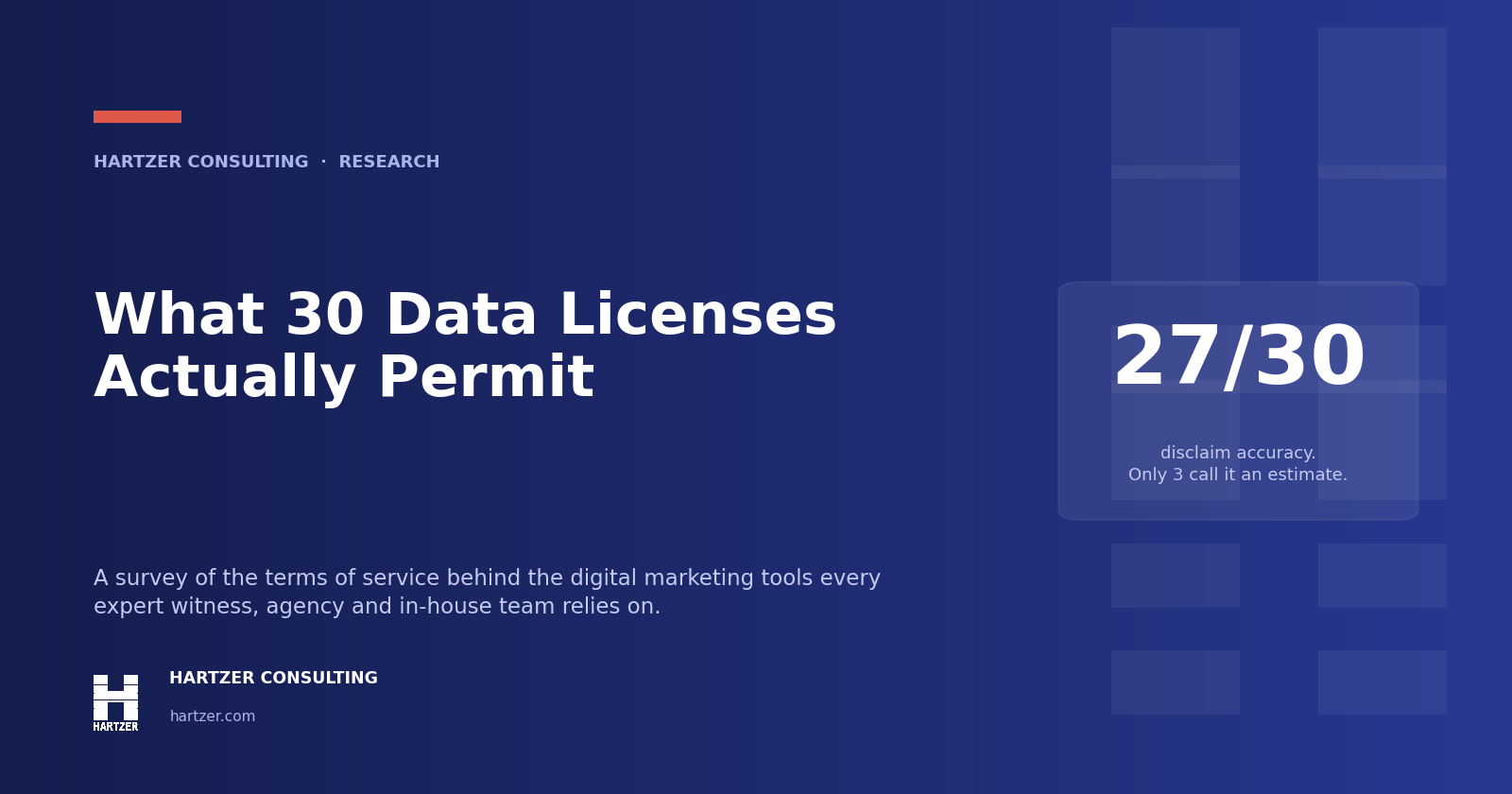
Twenty-seven disclaim the accuracy of their data; three describe that data as estimates. A warranty disclaimer limits liability. It is not a statement of measurement uncertainty, and the report treats the gap between those two numbers as its most consequential finding for anyone presenting these figures to a court or a client.
The restrictions are distributed counterintuitively. Domain and DNS forensics vendors, whose products are marketed to investigators and counsel, impose tighter publication restrictions than the search visibility tools. Free registry data published under ICANN and Verisign terms is the most permissive source surveyed.
The Evidentiary Framework
The report devotes a substantial section to what the rules actually require, because the licensing question and the admissibility question are governed by different bodies of law and answered by different decision makers.
A terms of service is a contract between a customer and a vendor. It cannot render a document inadmissible, and it is not a defense to a subpoena issued under Rule 45 of the Federal Rules of Civil Procedure. Admissibility is governed by the rules of evidence and decided by the court. Breach of the license is a separate matter with separate remedies, and both consequences can follow from the same act.
The report examines Rule 702 as amended effective December 1, 2023, the reasonable reliance standard under Rule 703, the disclosure obligations imposed by Rule 26(a)(2)(B) and how they interact with restrictive licensing, and authentication under Rules 901 and 902, including the self-authentication provisions added in 2017.
It also sets out how often expert testimony is actually excluded. Three independent empirical studies, covering different case types and different eras, converge near 45 percent, and reliability rather than qualifications is consistently the dominant ground of exclusion. An expert relying on data from a vendor that publishes no methodology is exposed on precisely that axis.

How Reliable Is the Underlying Data?
The report addresses reliability separately, because an expert must answer both questions and a client deserves an honest answer to the second.
A peer-reviewed study published in PLOS ONE in 2022 compared a leading traffic estimation platform against the sites’ own Google Analytics across 86 websites in 26 countries and 19 industry verticals over twelve months. The divergence is systematic rather than random: traffic volume is understated and engagement metrics are overstated, consistently and in a predictable direction.
That finding does not disqualify the tools. It defines what they are. A modeled estimate is well suited to establishing a pattern, a direction or a competitive picture, and poorly suited to carrying a precise factual assertion on its own. The report recommends that experts build opinions on first-party data the client controls and can authenticate, and treat third-party estimates as corroboration.
Recommendations
The report closes with practical guidance for three audiences. For expert witnesses and the attorneys who retain them, it addresses source selection, capture methodology, disclosure of commercial relationships with vendors, and what to do where a license restriction collides with a discovery obligation. For marketers publishing public analysis, it covers permission, attribution format and methodology disclosure. For vendors, it sets out what a measurement platform would need to publish to be relied on in a contested proceeding.
Availability
The report runs 28 pages and includes the full methodology, a coded appendix table covering all thirty agreements, and a complete source list. It is available to download at no cost and may be quoted and cited with attribution to Hartzer Consulting.
Attorneys, journalists and researchers who require the underlying coded dataset, or who have questions about the methodology, are invited to contact Hartzer Consulting directly.
This report is not legal advice and does not create an attorney-client relationship. Bill Hartzer is not an attorney. Anyone facing a specific licensing question, discovery obligation or evidentiary dispute should consult qualified counsel.