Can you put Semrush, Ahrefs, Similarweb or Google Analytics data in an expert witness report? Can you publish it on your blog? We read thirty license agreements to find out, and the answer is not what most practitioners assume.
Hartzer Consulting has published a 28-page research report examining a question the digital marketing industry has never systematically answered. Thirty published license agreements were retrieved, read in full, and coded on five dimensions. The findings were then compared against what the Federal Rules of Evidence actually require of an expert who relies on third-party data.
Download the Report (PDF, 28 pages)
No email required. Free to download, quote and cite with attribution.
What the Research Found
The survey covered search visibility tools, desktop crawlers, first-party analytics platforms, the Google product family, the four largest advertising platforms, panel measurement firms, domain and DNS forensics services, registry data sources, and the Internet Archive.
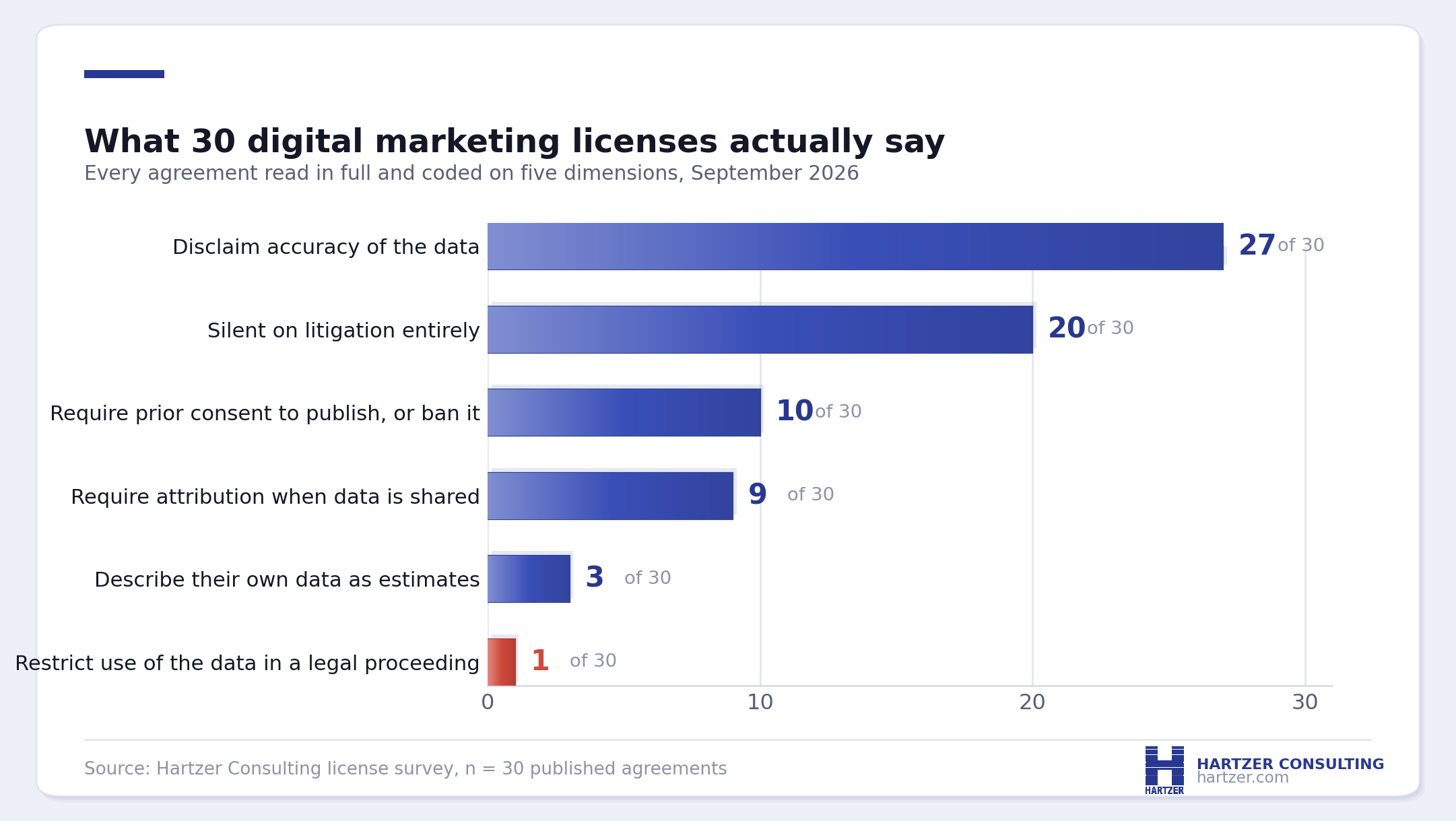
- Twenty of the thirty agreements are silent on litigation entirely. The words litigation, court, expert, testimony and evidence do not appear in any clause governing how a customer may use the data. Where they do appear, they sit in venue provisions, indemnity language, or definitions of legal process aimed at the vendor.
- Exactly one agreement addresses the question, and it says no. Comscore’s published Terms of Use bar a client from introducing the data into an investigation or court proceeding except when responding to a subpoena or other valid process. Compelled production is permitted. Volunteering it is not.
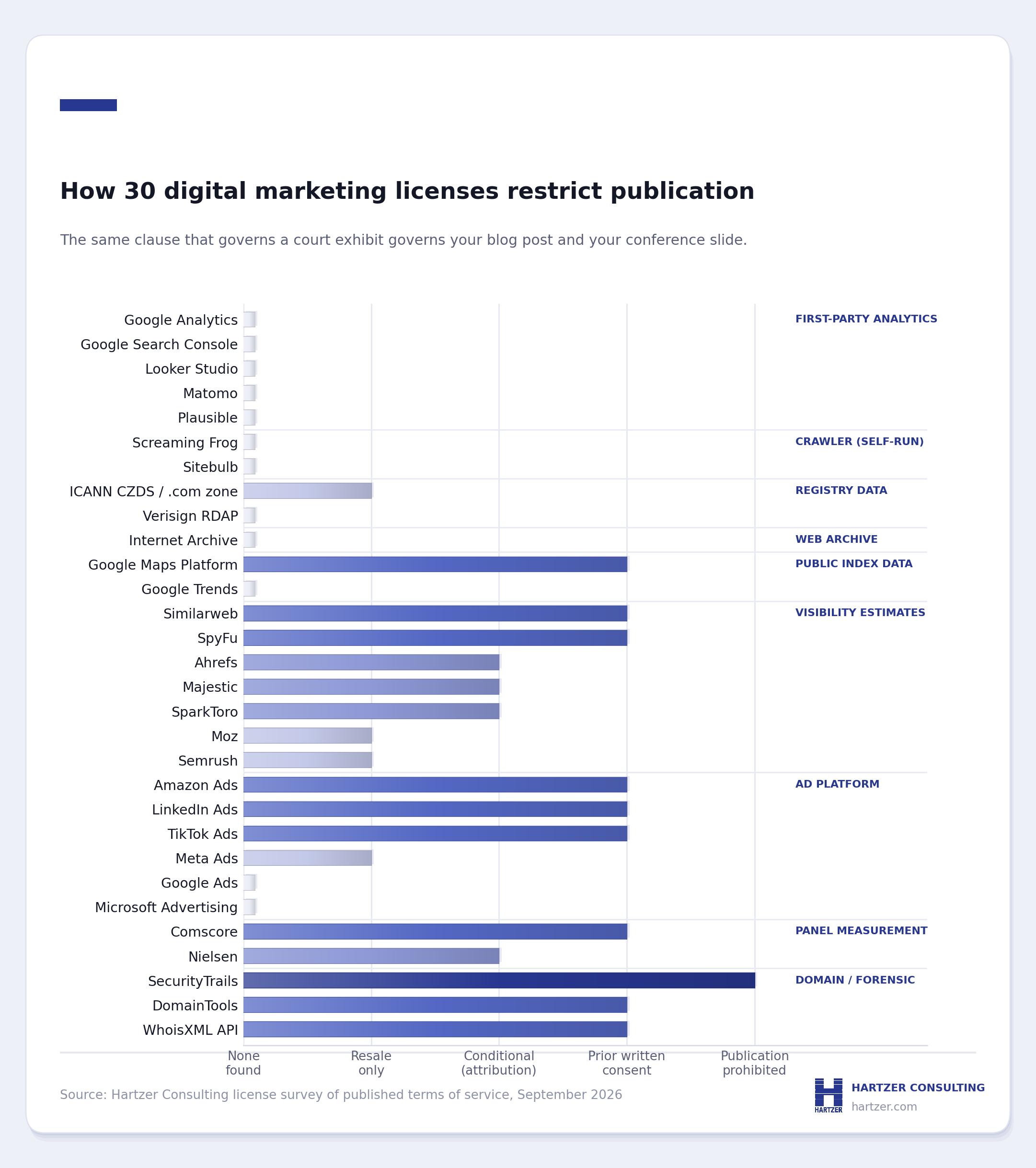
- Ten of the thirty require prior written consent before you publish the data, or prohibit publication outright. That clause reaches a blog post, a conference slide and a client proposal exactly as it reaches a court exhibit, and almost nobody in the industry has read it.
- Twenty-seven disclaim the accuracy of their data. Only three describe that data as an estimate. A warranty disclaimer is a liability instrument drafted by lawyers. It is not a statement of measurement uncertainty, and the two should never be confused.
- The restrictions sit where you would least expect them. Domain and DNS forensics vendors, whose products are marketed to investigators and counsel, impose tighter publication restrictions than the SEO tools do. Free registry data published under ICANN and Verisign terms is the most permissive source in the entire survey.
The Reliability Question Is Separate, and It Has an Answer
Whether a license permits you to publish a figure is one question. Whether the figure is accurate enough to carry the weight you are placing on it is another, and the report addresses both.
A peer-reviewed study published in PLOS ONE compared Similarweb against Google Analytics across 86 websites in 26 countries and 19 industry verticals over twelve months. The divergence is systematic rather than random: traffic volume is understated and engagement metrics are overstated, in a consistent direction.
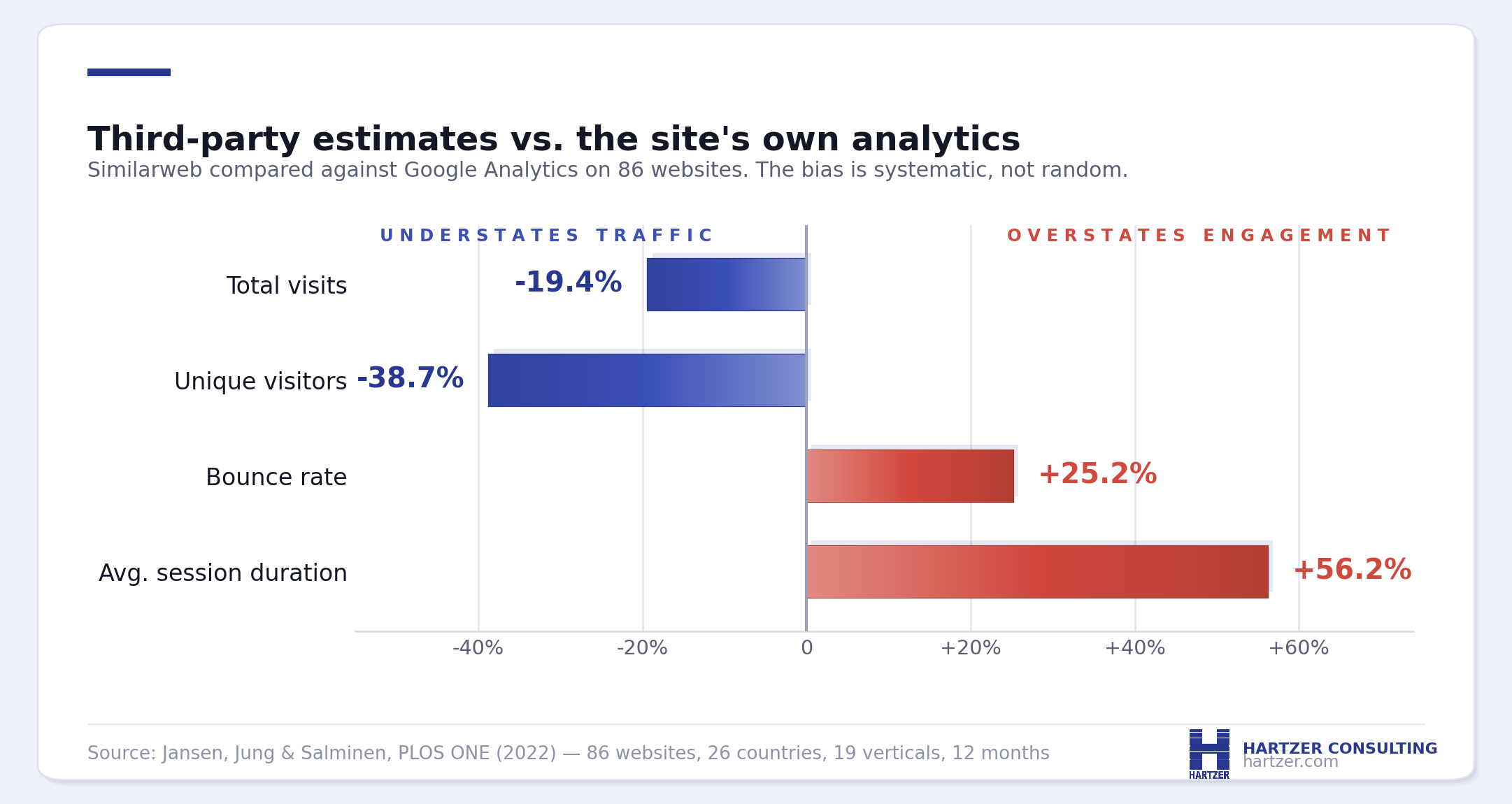
That is not an argument against using these tools. It is an argument for describing them accurately. A competitor’s monthly traffic figure is a model output with an error band the vendor has not published, and presenting it as a measured fact is a statement the vendor itself has declined to stand behind.
What the Report Covers
- An executive summary with five findings, each stated in a single paragraph
- The full methodology, including how each agreement was coded and where the coding involved judgment
- Six distinct license postures, with the practical consequence of each
- Why a terms of service is a contract and not a rule of evidence, and why conflating the two produces errors in both directions
- What Rules 702, 703, 901 and 902 require, and how Rule 26(a)(2)(B) disclosure obligations collide with restrictive licenses
- How often expert testimony is actually excluded, drawn from three independent empirical studies
- The Internet Archive model, including what its affidavit does and does not establish, the current fee schedule, and the reported turnaround
- Recommendations for expert witnesses and counsel, for marketers publishing public analysis, and for the vendors themselves
- A complete appendix table showing the coding for all thirty agreements, and a full source list
Who This Report Is For
Attorneys and expert witnesses. If your expert is relying on commercial marketing data, the report identifies where a license restriction can collide with a Rule 26 disclosure obligation, and what to raise before a report is served rather than after.
Agencies and in-house marketing teams. If you publish competitive analysis, present at conferences, or put third-party charts in client decks, the report tells you which licenses require permission first and which do not.
Analytics and measurement professionals. The report documents the gap between accuracy disclaimers and methodology disclosure across the entire tool category, with the peer-reviewed evidence on how far estimates depart from first-party data.
Vendors. The closing section sets out what a measurement platform would have to publish to be relied on in a contested proceeding, and why the first company to do it earns a commercial advantage.
Download the Report (PDF, 28 pages)
About the Author
Bill Hartzer is the founder of Hartzer Consulting and has spent more than 25 years working across search engine optimization, paid search, web analytics, domain names, internet infrastructure and online reputation management. He serves as an expert witness in matters involving search engine marketing, digital advertising, web analytics, website traffic analysis and domain ownership disputes, and has conducted forensic internet investigations for attorneys, corporations and government agencies.
This report is a product of that practice. It grew out of a conversation at a vendor booth at BrightonSEO in San Diego, and a realization that after 25 years of paying for these tools, he had never once read what their licenses actually permit.
Citation and Reuse
This report may be quoted and cited with attribution to Hartzer Consulting. The suggested citation is:
Hartzer, B. (2026). Third-Party Data in Expert Reports and Public Analysis: A survey of thirty digital marketing data licenses. Hartzer Consulting LLC.
Journalists, researchers and attorneys who need the underlying coded dataset or have questions about the methodology are welcome to get in touch.
Please note: this report is not legal advice and does not create an attorney-client relationship. Bill Hartzer is not an attorney. Anyone facing a specific licensing question, discovery obligation or evidentiary dispute should consult qualified counsel. Contract terms change, and every agreement discussed in the report should be confirmed at its source before being relied on.