Attorneys have started asking me a question at the retention stage that nobody asked three years ago: how do you use artificial intelligence in your work, and what will you be able to produce if the other side asks?
It is a fair question. It is also one most experts cannot answer well, because the answer has to exist before the question arrives.
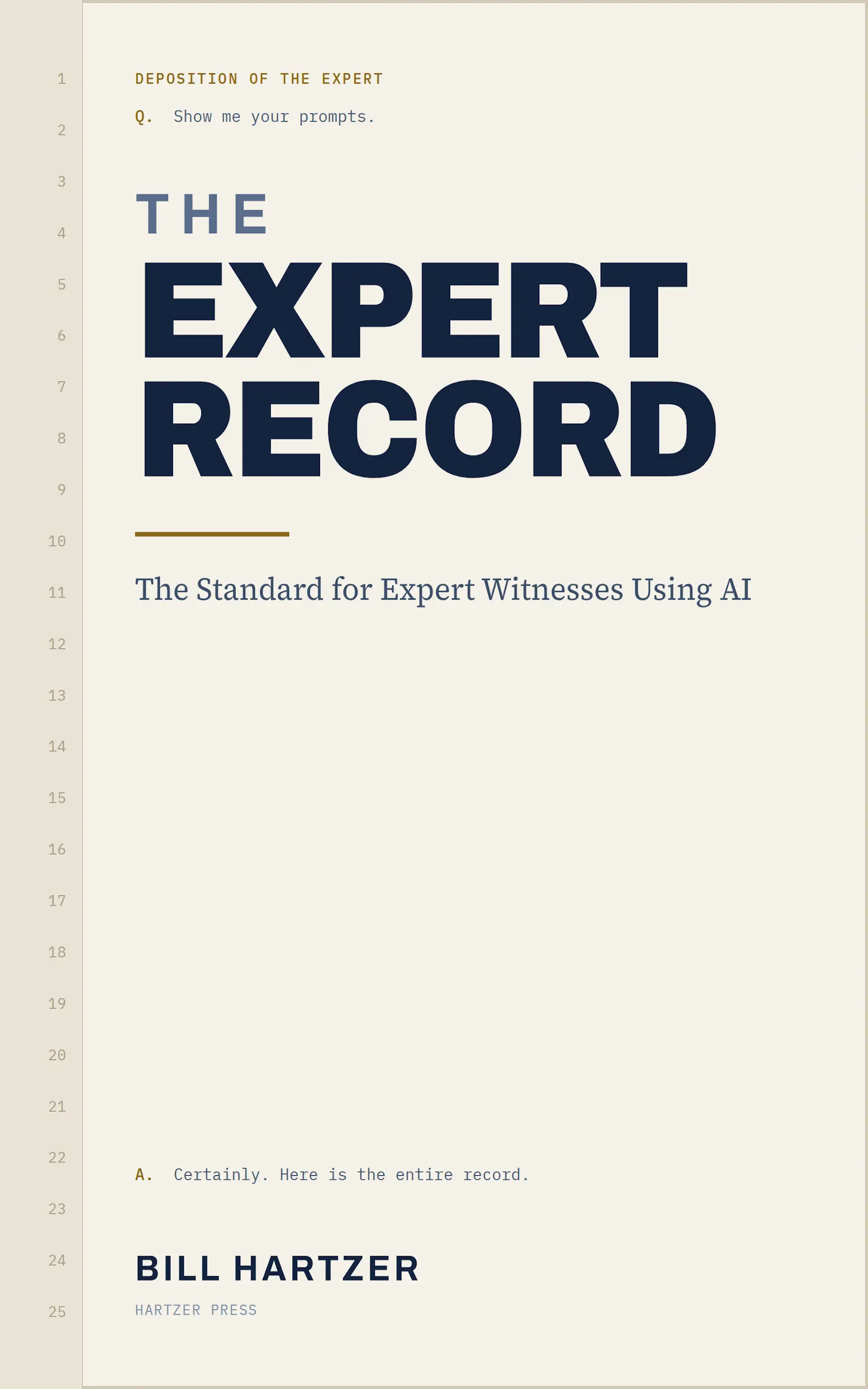
I have written a book about how to answer it. The Expert Record: The Standard for Expert Witnesses Using AI was published on September 27, 2026 by Hartzer Press. This post is about what it means for the engagements I take and for the counsel who retain me.
Where the problem actually comes from
My expert work involves data productions that cannot be read page by page. Server logs across several years. Advertising platform exports with hundreds of thousands of rows. Archived versions of a site captured at intervals across a decade. Domain and DNS (Domain Name System) history that has to be reconstructed from several registries.
No expert reads all of that unaided, and no expert ever did. The work has always involved tooling. What changed is that the tooling now produces prose, sounds confident, and leaves a complete transcript of everything it was asked.
That transcript is the shift. It is timestamped, verbatim, held by a third party, and increasingly producible in discovery. It exists whether or not the expert manages it.
The standard I work to
The book sets out the Expert Record Standard, version 1.0: eight clauses that fit on one page, written so a firm can lift them into an engagement letter without a lawyer rewriting them first.
One test governs all eight. An engagement satisfies the Standard when a competent examiner in the same field, working only from the primary sources and with no access to any AI system, could reproduce the expert’s result.
That is the line I hold on client work, and it decides more than it sounds like it does. It means any analysis producing a number, a count, a sequence or a selection gets performed by a method that returns the same answer when it is run again, and the method is preserved rather than only its output. A conversation with a chatbot cannot meet that bar. A script can, and a script is what I hand over.
What that looks like in a matter
Every review of data is a re-runnable script rather than a session. Every system used gets logged as the work proceeds, with what it was used for and what was done to check the output. Every citation, figure, date and characterization of a record is confirmed against a source that exists independently of any system, and I can name that source.
At retention I state that system use will be disclosed and the record produced on request. Saying it at the start costs nothing. Deciding it under cross-examination costs the engagement.
Why this matters to retaining counsel
A magistrate judge in Connecticut ordered a party to revise its discovery responses to produce the AI prompts an expert’s team had used to cull a document production, reasoning that an expert’s method is fair ground for discovery. That order was stayed on an objection and remained undecided as of mid-September 2026, so it is not settled law. It is a direction of travel, and one order like it in your matter is enough.
Trial courts have also split on whether a person’s own AI session records are protected at all. Three have reached different answers and no federal court of appeals has addressed it. Planning an engagement around the most protective of those answers is not planning.
The practical exposure for counsel is simpler than the doctrine. An expert whose method cannot be reproduced is an expert whose opinion can be attacked without ever discussing artificial intelligence. That attack has been available for as long as there have been experts, and unverified system output is a new way to hand it over.
Four chapters written for the attorney side
The last part of the book turns the material around: how to vet an expert’s AI practice before the engagement letter is signed, what to ask in a deposition of the other side’s expert, what each question is actually testing, and how to read the answers. There are deposition question sets for both directions, because the same method that defends your expert examines theirs.
What I am asking clients to do
Nothing that requires a purchase or a policy committee.
If you retain experts, ask the AI question at retention and ask for the log, not the reassurance. If you are an expert, start the log today for every open engagement and save a dated copy of the operative terms of service for the tier you actually use, because one federal court has already treated a provider’s published terms as the reason a user had no reasonable expectation of confidentiality. If a protective order governs your matter, read what it says about AI tools before any material goes near one. Some now bar open systems for every produced document, confidential or not.
I wrote the book the way I am describing. I kept a contemporaneous log of my own AI use from before the manuscript existed and published it in the appendix and on the companion site. A book about contemporaneous records that did not keep one would not be worth reading.
Where to find it
The Standard itself is free to read and licensed for adoption with attribution at theexpertrecord.com, separately from the book, because its purpose is to be used. The book is on Amazon in paperback, hardcover and Kindle.
If you are retaining an expert in a matter involving search, advertising, analytics, website traffic, domain names or an internet investigation, and you want to talk through how the work would be documented before you sign anything, get in touch.