A disavow file is a list of backlinks that a site owner asks Google to ignore when it assesses the site. Used correctly, it resolves a link-based manual action and protects a site from links it cannot get removed. Used carelessly, it discards links that were helping. Hartzer Consulting builds and maintains disavow files as part of its Google penalty recovery services and as a standalone engagement.
What Disavowing a Link Does
Google’s disavow links tool accepts a text file of URLs and domains. Google treats the listed links as if they carried a nofollow attribute, which means they no longer count for or against the site. Disavowing does not remove a link from the web, and it does not remove it from backlink reports. It is a request, and Google treats it as a strong suggestion.
When a Disavow File Is Needed
Hartzer Consulting gives clients a direct answer on this point: most websites do not need a disavow file. Google’s systems already ignore the majority of low-quality links, and every site of any age has some. A disavow file is appropriate in a limited set of situations.
- The site has a manual action for unnatural links
- The site has a history of paid links, link schemes, or large-scale link building that could lead to a manual action
- The site is the target of a negative SEO attack involving a large volume of spam links
- A domain name was acquired with a link profile built by a previous owner
Outside those situations, disavowing links because a tool labeled them “toxic” carries more risk than benefit. Toxicity scores are estimates produced by third-party tools. They are not Google’s assessment, and they regularly flag ordinary links.
How Hartzer Consulting Builds a Disavow File
Collect the Complete Link Profile
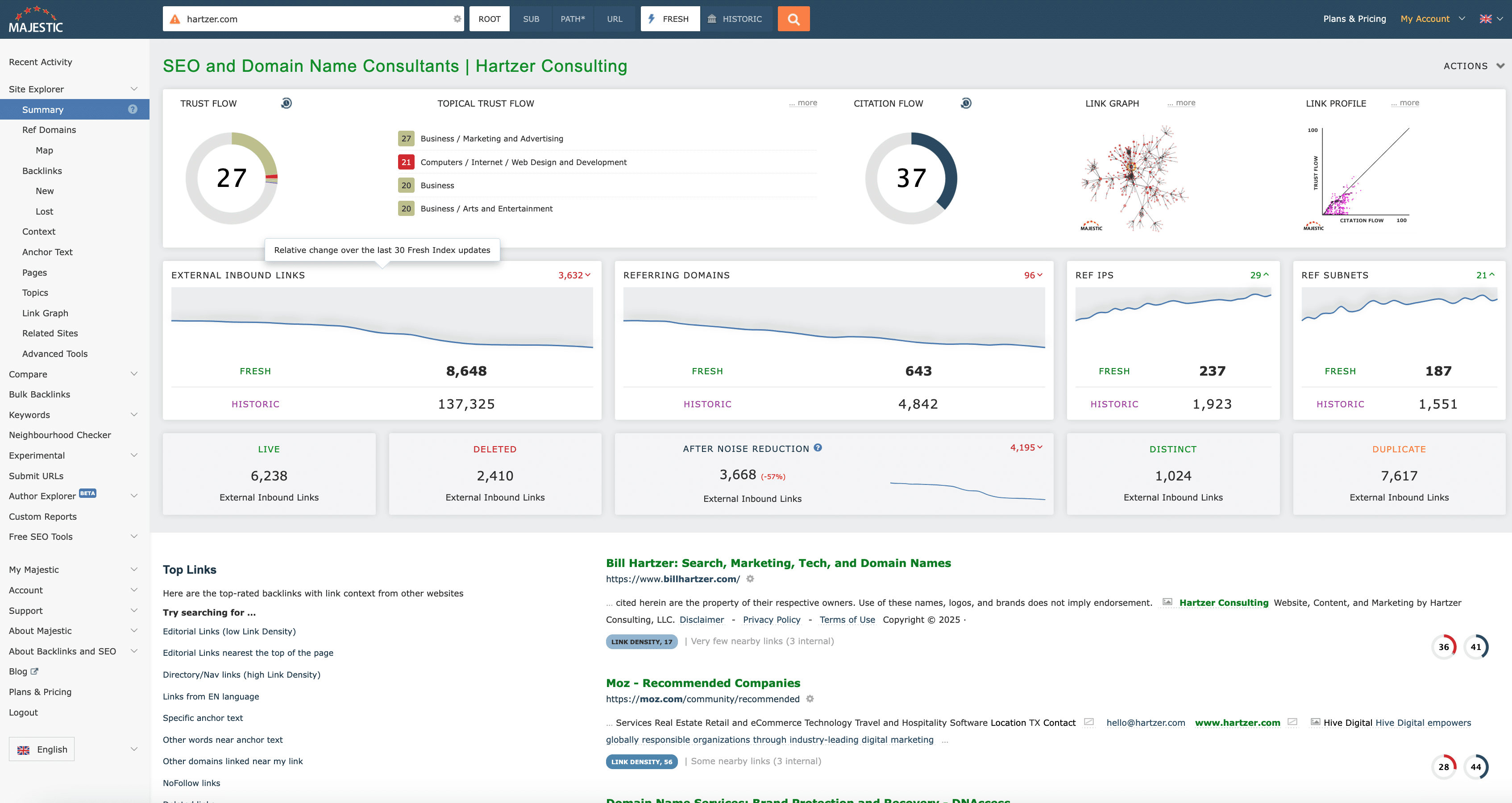
No single source lists every link. Bill Hartzer combines the links reported in Google Search Console with data from Majestic and Semrush, merges them into one list, and removes the duplicates.
Review the Links by Domain
Links are assessed at the level of the linking domain. The review considers what the linking site is, why the link exists, the anchor text used, and the pattern across the profile. A sudden cluster of links with the same commercial anchor text is a pattern. A single link from an obscure but genuine website is not a problem. Tool scores are used to sort the list, and every decision is made by reading the evidence.
Request Removal Where It Matters
For a manual action, Google expects an effort to have links removed at the source before they are disavowed. Removal requests are sent to the linking sites, and the requests and responses are recorded for the reconsideration request.
Build and Submit the File
The file is a plain text file with one entry per line. Hartzer Consulting disavows at the domain level, using the “domain:” prefix, because a spam site that links once usually links again from other pages. The file is uploaded in Google’s disavow links tool for the correct Search Console property. Each upload replaces the previous file, so the new file must contain every earlier entry that should remain.
Maintaining the File
A disavow file is a permanent record. It should be kept, dated, and carried forward through every redesign, website migration, and change of domain name, because a file uploaded for the old property does not apply to a new one. Where an attack is continuing, new links are reviewed on a schedule and the file is updated.
Common Disavow Mistakes
- Disavowing every link a tool marks as toxic, including links that were helping the site
- Uploading a new file that leaves out the entries from the old one
- Disavowing individual URLs when the whole domain should be listed
- Uploading the file to the wrong Search Console property, such as the HTTP version of an HTTPS site
- Forgetting to upload the file again after a domain migration
- Treating the disavow file as a substitute for removing links the site owner created and controls
What the Client Receives
- A reviewed list of linking domains with the decision and the reason for each
- The disavow file, ready to upload, or uploaded on the client’s behalf
- Removal request records, where a manual action is involved
- A schedule for reviewing new links, where one is needed
A full review of the link profile is described on the link audit page. To discuss a disavow file, contact Hartzer Consulting or call +1 214 236 4378.