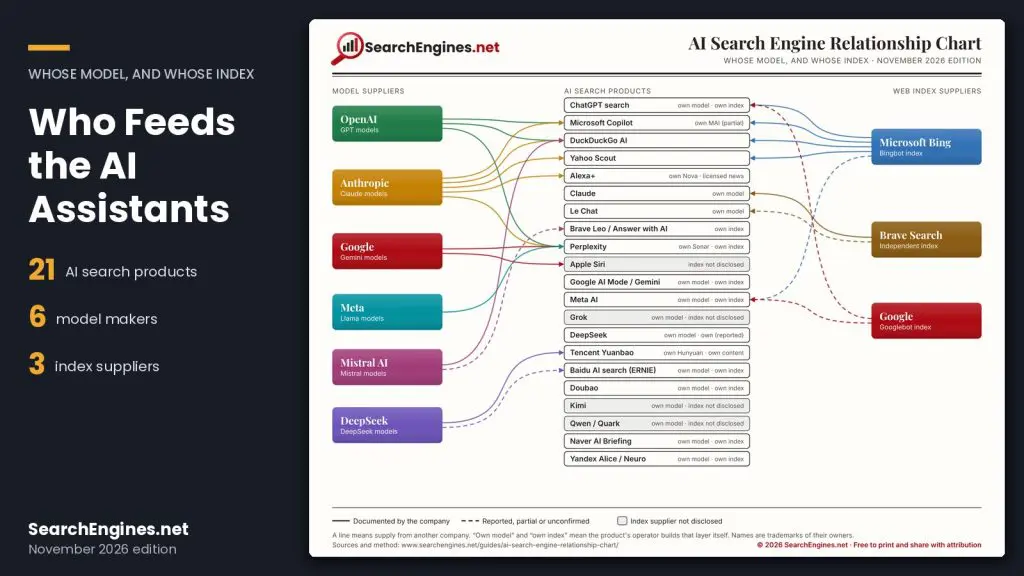
Four AI search products document Microsoft Bing as a source of their web results: ChatGPT search, Microsoft Copilot, DuckDuckGo AI and Yahoo Scout. A fifth, Meta AI, is reported to use it. That finding comes from the AI Search Engine Relationship Chart I published at SearchEngines.net on November 20, which tracks 21 AI search products, six model makers and three index suppliers.
Here is what that means for a business. An AI answer has two suppliers: a language model that writes it and a web index that supplies the pages it draws on. If your pages are missing from the index, the model has nothing of yours to retrieve. One caveat belongs up front: this is my chart, on a site I own, and it records only what companies document or what named press reports say.
So check Bing before you spend a dollar on “AI visibility.” When a client asks me how to show up in ChatGPT, my first question is whether Bing has their pages, and that check is part of every technical SEO audit I perform.
Where The Chart Came From
I did not invent the format. Bruce Clay, credited as the first person to use the term SEO (Search Engine Optimization), published his Search Engine Relationship Chart in 2000. It showed which engines borrowed results from which, and his company says nearly everyone in internet marketing had it on the wall. Bruce was a mentor and a friend, and he died this year.
I updated his idea for 2026 and put my own twist on it. The new edition for traditional engines covers 37 of them. Then I drew a second chart for AI search, because Bruce’s format assumed one supplier per engine. AI products have two.
Two Suppliers Behind Every AI Answer
The left side of the chart lists the model makers: OpenAI, Anthropic, Google, Meta, Mistral AI and DeepSeek. The right side lists the index suppliers: Microsoft Bing, Brave Search and Google. The 21 products sit in the middle, with lines running in from both sides.
Some pairings will surprise people.
- Yahoo Scout runs an Anthropic model on Bing’s index.
- DuckDuckGo AI offers models from OpenAI, Anthropic and Mistral AI on Bing’s index.
- Claude runs Anthropic’s own model on Brave Search’s index.
- Apple Siri runs a Google model on an index Apple has not disclosed.
Anthropic’s models appear in five products it does not operate. OpenAI’s appear in three. The brand on the answer box and the company doing the work are often different.
Which Indexes Matter For Your Business
Microsoft Bing
Bing carries the most weight on this chart. Four documented products and one reported product draw on its index. One of the four, ChatGPT search, also keeps an index of its own. Plenty of business owners watch Google Search Console every week and have never verified their site with Bing. That is a gap you can close in an afternoon.
Brave Search
Brave runs an independent index, one of the few built without Google or Bing. Anthropic documents Brave as the search provider behind Claude, and Mistral’s Le Chat is reported to use it too. If Bravebot cannot crawl your site, those answers are built without you.
Google supplies its own AI Mode and Gemini, as you would expect. Reports say ChatGPT search and Meta AI also draw on Google data, and I drew those as dashed lines because neither company has confirmed them.
What The Chart Does Not Tell You
Being in an index is the entry ticket. It is not a citation. The chart shows where a product looks, and it says nothing about which page the product picks once it gets there.
I also left blanks on purpose. Apple Siri, Grok, Kimi and Qwen have not disclosed an index supplier, so they get no line. I did not infer a relationship from how an answer looks, and I would be skeptical of anyone who does.
The same skepticism applies to shortcuts. I wrote earlier this year about companies buying brand mentions to influence AI answers, and Google’s representatives have reportedly compared that practice to paid links. Fix the plumbing first. It is cheaper, and it does not come with a penalty.
What To Do Next
None of this requires new software. It requires an hour and access to your own site.
- Verify your site in Bing Webmaster Tools and submit your XML sitemap.
- Read your robots.txt file and confirm it allows Bingbot, OAI-SearchBot, Claude-SearchBot, PerplexityBot and Bravebot.
- Review your server or CDN (content delivery network) settings, because bot-blocking rules there can stop these crawlers before robots.txt is ever read.
- Set up AI referral tracking in Google Analytics so you can see which assistants already send visitors.
- Download the chart, which is free to print and share with the attribution and edition date left on.
AI products change suppliers often, and that is why the chart carries an edition date. The November 2026 edition will not be the last.
The lesson is the one Bruce’s chart taught in 2000. Know who supplies whom, and you know where to do the work.